Unicode Superscript & Subscript: Complete Beginner-to-Advanced Guide
Unicode superscript & subscript characters play a crucial role in modern digital writing. From chemistry formulas like H₂O and physics equations such as E = mc² to academic references, mathematical expressions, and styled social media text, superscript and subscript formatting is everywhere.
This complete guide explains what Unicode superscript & subscript are, how they work, why Unicode is better than HTML formatting, where these characters are supported, their limitations, and why using an online Unicode generator is the most reliable solution.
Whether you’re a student, researcher, developer, blogger, or content creator, understanding Unicode superscript and subscript will help you format text correctly across all platforms.
What Is Unicode?
Unicode is a universal character encoding standard that assigns a unique code to every character, symbol, letter, and number used in digital text. Its purpose is to ensure that text appears consistently across all devices, operating systems, browsers, and applications.
Before Unicode, text encoding varied by platform and language, often causing symbols to break, appear incorrectly, or turn into unreadable characters. Unicode solved this problem by creating a single, global standard.
Today, Unicode supports:
- Letters from all major languages
- Mathematical symbols
- Currency signs
- Emojis
- Superscript and subscript characters
Because Unicode is platform-independent, text encoded using Unicode works reliably in Google Docs, Microsoft Word, WordPress, HTML content, PDFs, emails, and social media platforms.
Why Unicode Is Better Than HTML for Superscript & Subscript
Many people use HTML tags like <sup> and <sub> to create superscript and subscript text. While this works inside web pages, it has serious limitations.
Unicode vs HTML Superscript & Subscript
- HTML formatting:
- Only works inside HTML-supported environments
- Breaks when copied into documents, emails, or social media
- Requires coding knowledge
- Often loses formatting when pasted elsewhere
- Unicode superscript & subscript:
- Are actual characters, not visual styling
- Work everywhere Unicode is supported
- Stay formatted when copied and pasted
- Require no HTML or CSS
For example, HTML superscript like <sup>2</sup> may look correct on a webpage but will lose formatting when pasted into Google Docs or a social media bio. Unicode superscript ², on the other hand, remains intact everywhere. Read our complete guide on superscript in Google Docs.
This is why modern tools including our Superscript & Subscript Generator use Unicode characters instead of HTML tags.
Unicode includes a specific set of superscript characters commonly used in mathematics, science, and references.
Unicode Superscript & Subscript Characters
The table below shows commonly supported Unicode superscript and subscript characters used in mathematics, science, engineering, and academic writing. These are the exact characters generated by Unicode-based tools and are compatible across documents, web platforms, and social media.
| Character | Superscript | Subscript |
|---|---|---|
| 0 | ⁰ | ₀ |
| 1 | ¹ | ₁ |
| 2 | ² | ₂ |
| 3 | ³ | ₃ |
| 4 | ⁴ | ₄ |
| 5 | ⁵ | ₅ |
| 6 | ⁶ | ₆ |
| 7 | ⁷ | ₇ |
| 8 | ⁸ | ₈ |
| 9 | ⁹ | ₉ |
| + | ⁺ | ₊ |
| − | ⁻ | ₋ |
| = | ⁼ | ₌ |
| ( | ⁽ | ₍ |
| ) | ⁾ | ₎ |
| a | NA | ₐ |
| e | NA | ₑ |
| h | NA | ₕ |
| i | ⁱ | NA |
| k | NA | ₖ |
| l | NA | ₗ |
| m | NA | ₘ |
| n | ⁿ | ₙ |
| o | NA | ₒ |
| p | NA | ₚ |
| s | NA | ₛ |
| t | NA | ₜ |
| x | NA | ₓ |
Note: “NA” means Unicode does not officially support that character in superscript or subscript form.
For a deeper understanding, read our dedicated guides on what is superscript and what is subscript, where each is explained with real-world examples and proper Unicode usage.
How These Unicode Characters Are Used
Unicode superscript and subscript characters are widely used across multiple disciplines:
- Mathematics: Exponents (x², y³), indices, powers, and equations
- Chemistry: Chemical formulas and compounds (H₂O, CO₂, H₂SO₄)
- Physics & Engineering: Scientific notation (10⁶), variables, equations, and units
- Academic Writing: Footnotes, references, ordinals (1ˢᵗ, 2ⁿᵈ), and annotations
Because these are true Unicode characters, they remain correctly formatted when copied into Google Docs, Microsoft Word, WordPress, PDFs, emails, and social media platforms.
Where Unicode Superscript & Subscript Works
One of the biggest advantages of Unicode superscript and subscript is cross-platform compatibility.
Unicode characters work reliably in:
- Google Docs
- Microsoft Word
- WordPress & CMS platforms
- HTML and plain text
- PDF documents
- Emails
- Social media bios and captions
- Messaging apps
- Academic & research platforms (LaTeX viewers, journals)
- Programming environments & code editors
- Design tools (Canva, Figma, Adobe apps)
- Search engines & SERP snippets
- Note-taking apps (Notion, Evernote, OneNote)
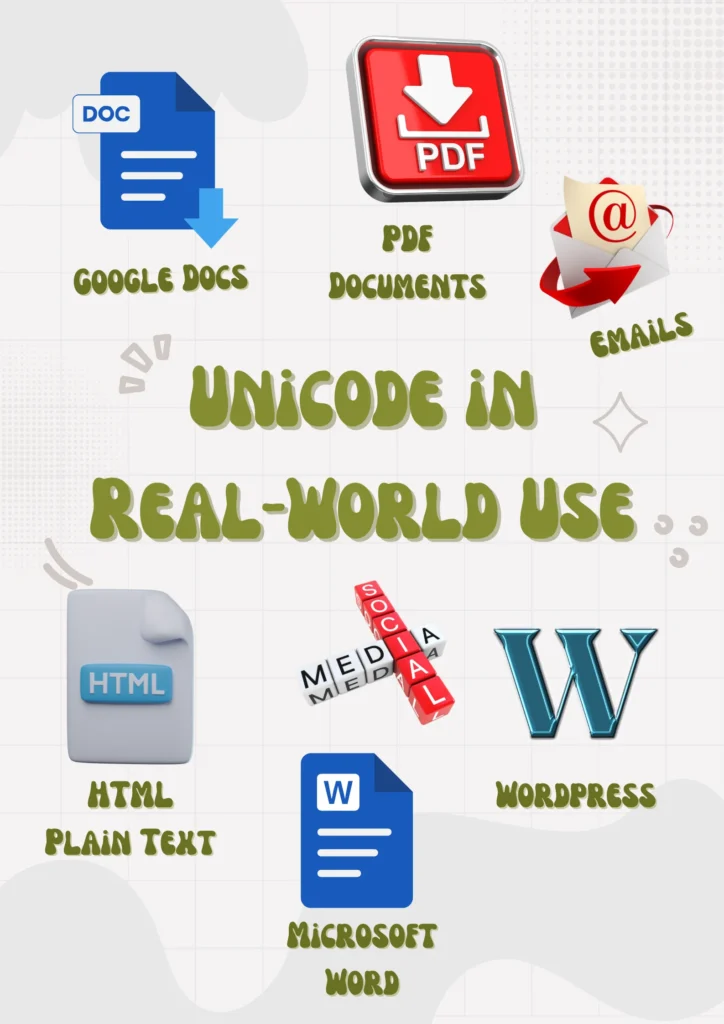
Because Unicode characters are part of the text itself, they do not depend on formatting rules, fonts, or editors. Read our complete guide on subscript in Google Docs.
Unicode Limitations (What Cannot Be Converted)
While Unicode is powerful, it does have limitations.
Key Limitations of Unicode Superscript & Subscript
- Not all letters have superscript or subscript equivalents
- Complex mathematical expressions may not fully convert
- Styling (bold, italics) does not apply separately
- Unicode does not replace full equation editors like LaTeX. (See our guide to superscript and subscript in LaTeX for details.)
For example, Unicode supports superscript numbers well, but not every alphabet character has a superscript or subscript version. This is why some advanced scientific expressions require specialized tools.
A good Unicode generator handles these limitations intelligently by converting only supported characters and leaving the rest unchanged.
Why Use Our Online Superscript & Subscript Generator
Manually typing Unicode superscript and subscript characters is slow, inconsistent, and frustrating. Keyboard shortcuts differ across devices, and built-in character maps are difficult for most users to navigate.
Our Unicode Superscript & Subscript Generator eliminates these issues by giving you a fast, reliable, and user-friendly way to format text correctly online. With our tool, you can:
- Instantly convert text into Unicode superscript or subscript
- Mix superscript and subscript in the same line with precision
- Avoid formatting errors across apps, browsers, and platforms
- Copy clean, ready-to-use Unicode text in one click
- Use the tool directly from your browser, no installation or setup required
Designed for students, developers, scientists, and everyday users, our online tool makes complex formatting effortless.
If you want accurate results without wasting time, click below for using our Superscript and Subscript Generator, which is the fastest and most dependable solution.
Use Unicode Superscript & Subscript Instantly
If you want accurate, copy-ready Unicode superscript and subscript text that works everywhere, use an online generator designed specifically for this purpose.
Superscript & Subscript Generator:
- Uses true Unicode characters
- Supports both full-text conversion and mixed formatting
- Works across documents, web, and social media
- Requires no HTML, shortcuts, or technical knowledge
By understanding Unicode superscript and subscript and using the right tool you can format text professionally, consistently, and without frustration.
Frequently Asked Questions
Final Note
Unicode superscripts & subscripts characters are the most reliable way to format text across documents, websites, and social platforms. While Unicode has natural limitations, using a dedicated online generator removes guesswork, prevents errors, and saves time. By combining Unicode knowledge with the right tool, you can format text accurately, consistently, and professionally everywhere it matters.